
Military History of the USS
Strong
Radio CW Call Sign = NTRR


Voice Call = WHITECAP
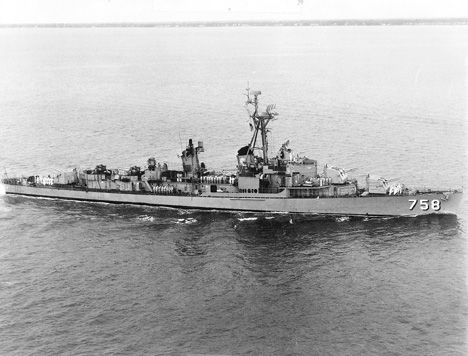
The second
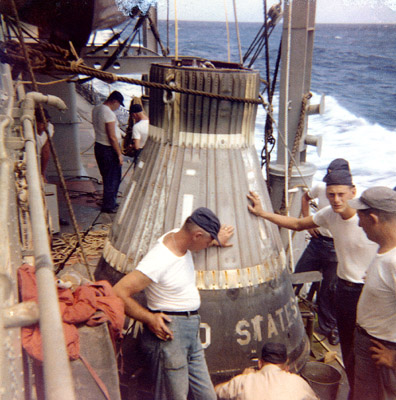
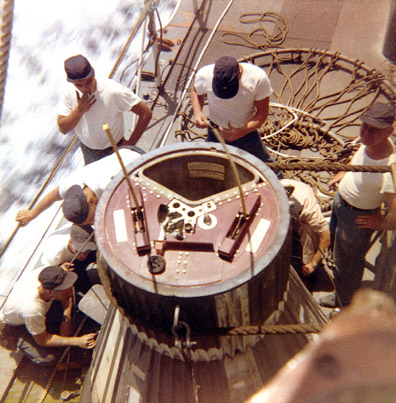
Strong (DD-758) was laid down on 25 July 1943 by Strong transited the Panama Canal on 11 January 1946 and arrived at New York on the 15th. After a period of upkeep and repairs, she operated along the northeast coast until rapid demobilization kept her at Boston from 29 April until 1 August. She put to sea again and operated with the fleet as far south as the Gulf of Mexico until she sailed into Charleston, S.C., for inactivation and berthing. The destroyer was placed in reserve, out of commission, on 9 May 1947 as a unit of the Atlantic Reserve Fleet. Strong was placed in commission again on 14 May 1949 and held shakedown training in Guantanamo Bay, Cuba, during September and October. Her home port was designated as Norfolk, Va., and she sailed from there with 2d. Fleet units for operations near the Arctic Circle. Fleet exercises Portrex and Carribex were held during March 1950 and, during June and July, Strong embarked midshipmen and reservists for a training cruise to Panama and Cuba. In late August, she sailed for the Mediterranean Sea, and her first deployment with the 6th Fleet which lasted until February 1951. Routine fleet duties followed until 15 May 1952 when she steamed from Norfolk with Destroyer Divisions (DesDiv) 21 and 262 for the Korean War Zone, via Panama, San Diego, Pearl Harbor, and Yokosuka. Strong sailed from Yokosuka on 19 June for Korean waters and was attached to Task Force (TF) 77 which launched the first attacks against the hydroelectric plants on the Yalu River five days later. The destroyer was in Japan from 9 July to 13 September and returned to Korean waters where she operated until 9 October. During her tour in Korea, she conducted gun strikes up and down the east coast; served with the United Nations Blockade and Escort Group on the west coast; and was at Pusan, Songjin, and Wonsan. On 9 October, Strong sailed to Yokosuka on her way back to Norfolk via Singapore, Ceylon, Bahrain, Aden, Suez, Naples, and Villefranche. She arrived at her home port on 12 December 1952. Strong operated along the east coast until early January 1954 when she stood out of Norfolk for another tour in the Far East and another world cruise which did not see her back in her home port until 10 August. She resumed her routine duties along the east coast until 13 August 1956 when she sailed for another four month deployment period with the 6th Fleet. The destroyer was deployed to the 6th Fleet again in 1957, 1958, and 1961. In 1958 she saved 13 Bahrenians in the Persian Gulf during a severe storm. In 1959, she participated in "Project Mercury" and recovered the "Big Joe" capsule off Puerto Rico.
Click on the thumbnail images to
ENLARGE.
Mercury H-2 Project "Big
Joe" Capsule
Top view of "Big Joe" capsule,
taken from 01 level
USS Strong DD-758 1960
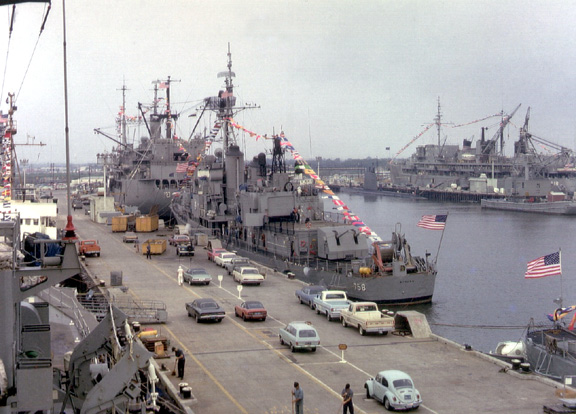
Strong sailed from Subic Bay, P.I., on 15 December as screen for Coral Sea (CVA-43) enroute to her first assignment in Vietnam, Operation "Sea Dragon." From 18 December 1967 to 2 January 1968, she was on the gunline conducting harassment and interdiction missions against North Vietnamese water borne logistic craft. From 3 January to 5 February she operated at "Yankee Station." Strong was ordered to the Sea of Japan from 23 February to 6 March after the North Koreans seized Pueblo (AGER-2). She was back off Vietnam on April and assigned to duties in the III Corps Tactical Zone and Rung Sat Special Zone. During the first two weeks, she sank 20 enemy sampans as well as providing fire support. From 22 April to 1 May, Strong served as II Corps naval gunfire support ship, firing against Viet Cong targets in the Phan Thiet area. On 1 May, she sailed for the east coast, via Okinawa, Japan, Midway, Hawaii, California, Mexico, and the Panama Canal, and arrived at Charleston on 4 August. Strong sailed on 11 September to participate in NATO exercise Operation "Silver Tower" in the Norwegian Sea. After a visit to Gravesend, England, she returned to Charleston on 15 October 1968 and remained there until 9 January 1969 when she resumed routine peacetime training. On 12 November 1969, the destroyer was again deployed to the 6th Fleet for a six month tour and returned to her home port on 23 May 1970. Much of the remainder of the year was spent in port and she was again deployed to the 6th Fleet from 16 April to 16 October 1971. On 16 November, she was transferred to the Naval Reserve Force and became a unit of DesRon 34. Strong operated as a naval reserve training ship until September 1973 when she entered a standdown period at Charleston. Click on the thumbnail images to
ENLARGE.
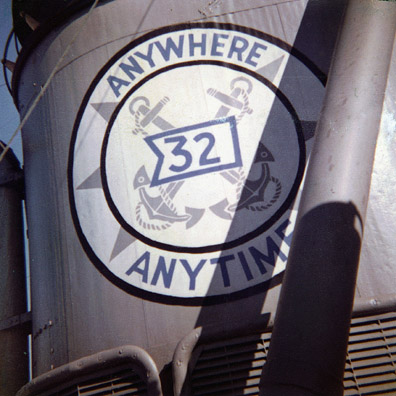
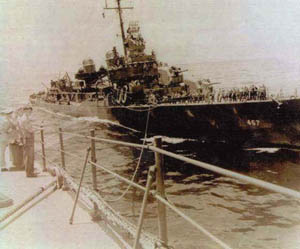
USS Yellowstone AD-27 is just forward of USS
Strong
The following E-mail was received from IC3
Sam Goforth on 9-19-1999 at 10:34 PM. "I was the
duty IC tech on board the Strong for her last cruise. Actually, it was Sam Goforth, former IC3 on the USS Yellowstone (AD-27) from 1971 to 1974." Unquote Strong was decommissioned and struck from the Navy list on 31 October 1973. She was transferred to the government of Brazil the same day as Rio Grande De Norte (D-37).
ADDENDUM: During 1953, Strong visited the following
ports: Norfolk, VA On 4 January 1954, Strong left
Norfolk, VA for Korea on her second Awarded: American Area Campaign Medal, Asiatic-Pacific Campaign
Medal, World War II Article Source: Seaweed's Ships Histories 1-800-SEAWEED Addendum Source: The Captains of the Ship"Only a seaman realizes to what great extent an entire ship reflects the personality and ability of one individual...her Commanding Officer. To a landsman, this concept is difficult to understand, and for us mariners, it may be hard to comprehend, but it is so. A ship at sea is a different world unto herself. In consideration of the protracted and distant operations of the fleet units, the Navy must place great power, responsibility, and trust in the hands of those leaders chosen for command. In each ship, there is one man who, in the hour of emergency or peril at sea, can turn to no other man. There is one man who alone is ultimately responsible for the safe navigation, engineering performance, accurate gunfire, and morale of his ship. He is the Commanding Officer. He is THE SHIP." This assignment is the most demanding and difficult in the Navy. There is not an instant during his tour as Commanding Officer that he can escape the grasp of command responsibility. His privileges in view of his obligations are almost ludicrously small; nevertheless, this is the spur which has given the Navy its great leaders. It is a duty which most richly deserves the highest, time-honored title of the seafaring world..... CAPTAIN!" -Joseph Conrad
THE LAST US NAVAL OFFICER TO
LEAVE THE USS STRONG WAS LT. CLEM SHEMANSKI
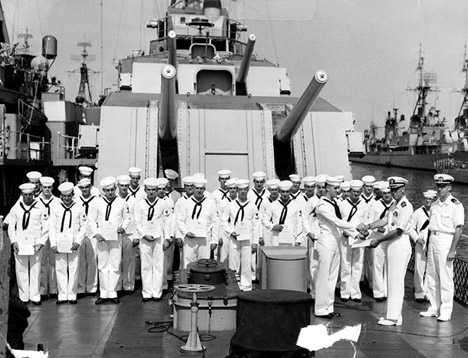
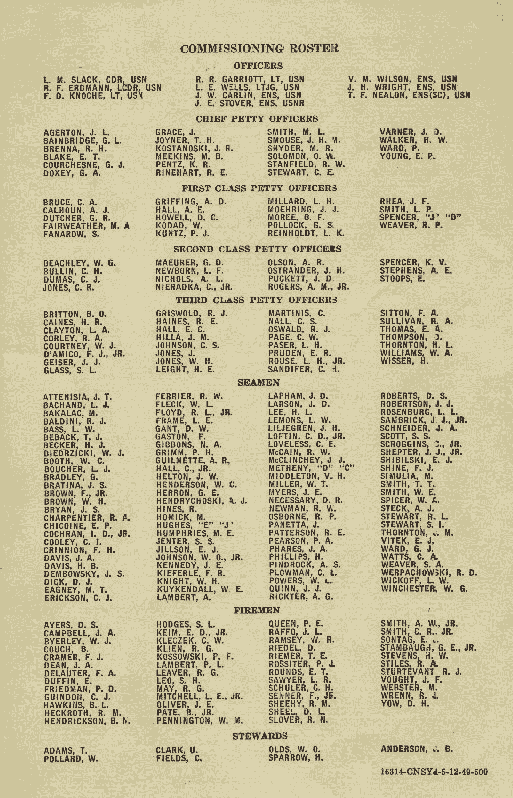
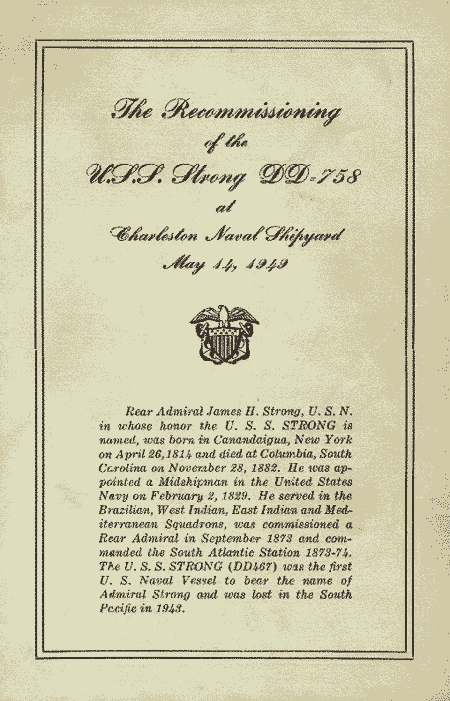
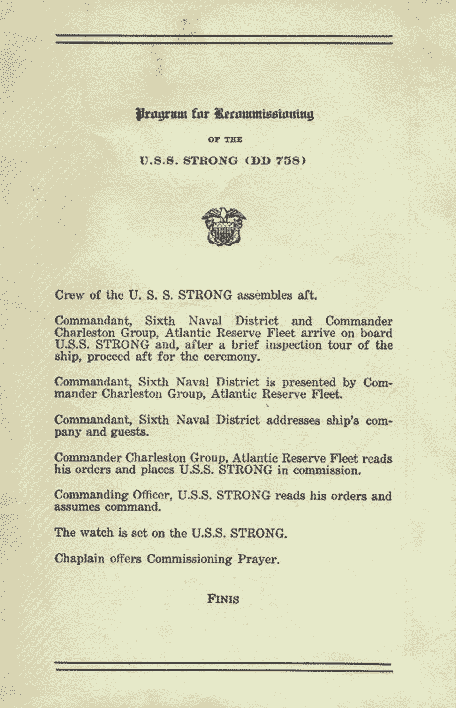
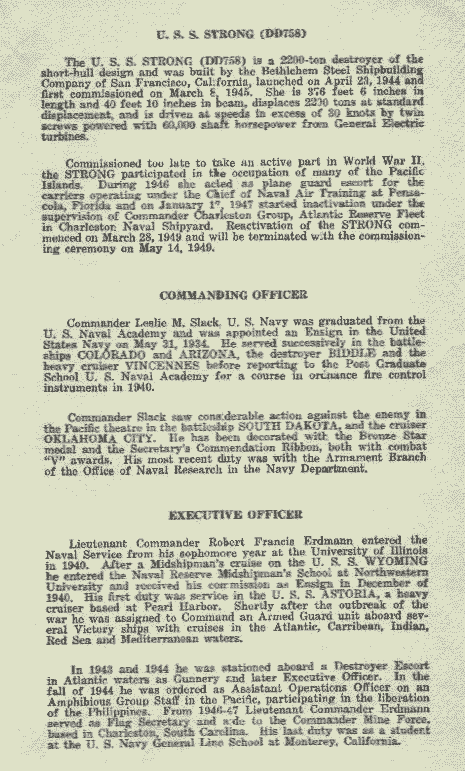
Recommissioning Images Recommissioning Dedication Recommissioning Program Recommissioning Officers and History
For a history of the first USS Strong DD 467, return to home page and scroll down.
|